

Dubai Property Price Predictions 2026 – Oversupply or Smart Opportunities?
The Dubai property market has always been one of the most closely watched real estate landscapes in the world. End users, developers, and investors ar...

Dubai’s real estate market has always been one of the most closely watched in the world. From end-users and investors to developers, every market participant keeps an eye on transaction volumes, price trends, and the city’s supply pipeline. As we approach 2026, two dominant themes are shaping investor and buyer sentiment: oversupply risks and a potential property price correction.
While Dubai continues to witness strong investor appetite and off-plan launches, the 2025 market has already shown early signs of transformation. Buyer behavior is evolving, rental growth is moderating, and a record wave of unit deliveries is looming on the horizon. The question is, will oversupply drive prices down, or is Dubai’s growth story set to continue with minimal disruption? This comprehensive blog explores these dynamics in depth, drawing on published H1 2025 data and external forecasts rather than providing guarantees, combining H1 2025 data, supply projections, price forecasts, rental trends, and district-level insights to help investors make informed decisions.
From Forecast to Reality: H1 2025 Market Insights
Dubai’s property market in H1 2025 has been a story of strong growth with early signs of moderation, particularly in pricing and rents. Understanding the gap between forecast and reality provides a clearer picture of the market heading into 2026.
Transaction Volumes
Forecast: Analysts predicted a healthy transaction flow driven by new launches and high liquidity, with residential sales projected to rise steadily.
Reality: The market exceeded expectations. Residential sales in H1 2025 reached approximately AED 326.7 billion across 99,000 transactions, representing a remarkable 40% year-on-year growth. Q2 2025 alone recorded AED 184 billion in sales, a new quarterly record and roughly 49% higher than Q2 2024.
Villas and apartments together accounted for AED 262.7 billion, up 38% YoY, while the deal volume rose around 23%. Apartment transactions jumped from 63,300 to 73,600 deals (+16%), with transaction value up approximately 21% between Q1 and Q2.
Modi, Dubai Market Analyst, notes, “Dubai’s liquidity remains robust, and the end-user demand is increasingly driving the market rather than pure speculation.”
Price Performance
Forecast: Price growth was expected to moderate after strong 2024 gains, with prime areas leading the appreciation.
Reality: Prices have continued to rise, albeit in a tiered pattern:
- Average residential price per square foot: AED 1,607 in Q2 2025 (+6% YoY), nearly 70% above the 2021 trough.
- Villas: +19% YTD, with Emirates Hills +45% and Jumeirah Golf Estates +19%.
- Core apartment zones: 12–14% growth (Downtown, JVC, Emaar Beachfront).
- Mid-tier communities: 3–10% (Dubai Silicon Oasis, Sports City, International City).
This data highlights scarcity-driven growth in prime zones, steady gains in core apartments, and slower but stable growth in mid-market segments.
Supply & Demand Balance
Oversupply occurs when the number of units delivered outpaces the number of buyers or tenants. For example, if 30,000 new apartments are completed in a year, but only 20,000 units are demanded, developers face competition, leading to price adjustments and rent moderation.
Reality in H1 2025: Dubai’s market has absorbed much of the new supply so far, supported by strong end-user demand and off-plan confidence. However, the stage is set for localized pricing pressures, especially in apartment-heavy districts.
Off-Plan vs Secondary Market & Rental Yields

Dubai’s property market is maturing, balancing both forward-looking off-plan strategies and immediate-use secondary sales.
- Off-plan deals: ~66% of Q2 2025 transactions (~35,400 deals, AED 122.6 billion).
- Secondary/resale market: Transactions up ~27% YoY; H1 resale value ~AED 61.5 billion.
- Gross rental yields: Apartments 6.5–6.8% and villas 5–5.5%, with some short-term rentals achieving higher returns.
Insight: Investors are increasingly confident in off-plan opportunities, while the secondary market remains active, providing choices for immediate use or rental income.
According to market analysts, “Off-plan projects are no longer just speculative plays; they are a strategic part of a diversified investor portfolio.”
Supply Wave 2025–2026 and Historical Comparison
The supply surge is the key factor shaping Dubai’s 2026 outlook.
Projected Deliveries
- On paper: ~90,000 units in 2025, ~120,000 units in 2026 → total stock grows from ~840,000 to ~1 million.
- Adjusted realistic completions: Of the forecasted ~37,000 units for 2025, ~22,900 (62%) are expected; for 2026, ~34,700 (48%) likely. Combined, ~57,600 units realistically delivered over two years.
- H1 2025: Already saw 20,000+ handovers; full-year estimate ~72,000 units.
Comparison with Historical Supply
- 5-year average annual handovers: ~35,500 units.
- Pre-2024: 20,000–40,000 units/year; 2024 ~25,000–30,000 units.
- 2026 projected: ~120,000 units → triple historical average.
Implications: Even conservative estimates represent a step-change in supply, increasing the potential for localized oversupply in apartment-heavy districts. Historical completion rates (50–60%) temper this risk, but selective price pressure is widely viewed as likely rather than guaranteed.
Pricing and Financial Forecasts (Late 2025 – 2026)
Dubai’s price growth in 2026 is expected to moderate yet remain resilient, segmented by property type and location. The figures below are indicative forecasts from various market reports, not certainties:
Key Insight:
- Prime areas: Continue upward trajectory.
- Secondary/suburban zones: May experience price softening due to oversupply.
- Investor takeaway: Strategic selection of high-demand locations is crucial, and outcomes may differ from these ranges depending on macro conditions.
Rental Market Trends
The rental market is showing signs of moderation:
- Year-on-year rent growth slowed to ~8.5% by May 2025 (down from 14.3% in January).
- Tenant leverage is rising due to increasing supply.
- Yields: Apartments 6.3–6.8%, villas 5–5.5%, still attractive for long-term investors.
According to market analysts, “The rental market is stabilizing, giving tenants more bargaining power, but prime zones remain highly profitable for investors.”
District Performance & Hotspots
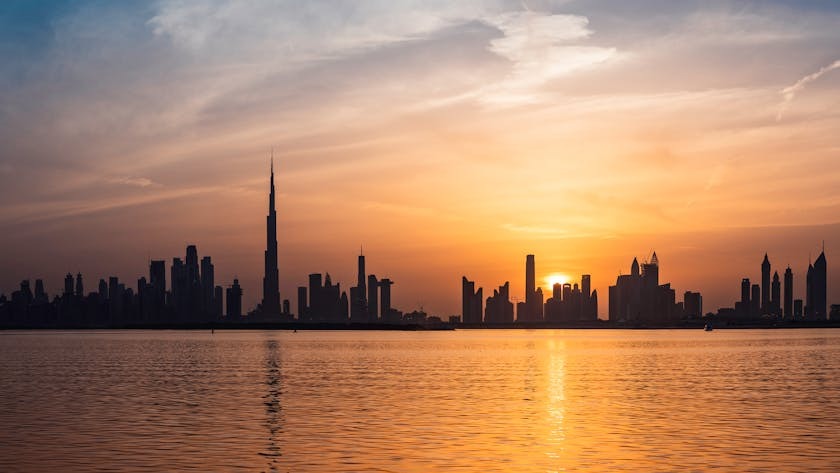
Luxury & Prime
- Palm Jumeirah, Downtown Dubai, Dubai Hills Estate, JLT.
- High appreciation and occupancy; branded residences command 30–40% premiums.
Mid-Market & Family-Friendly
- Arabian Ranches, Business Bay.
- Stable yields, family-oriented; end-user demand dominates.
Emerging & Off-Plan Growth
- Dubai South, JVC, Arjan, Sobha Hartland, Dubai Creek Harbour, Expo City.
- Price-sensitive buyers; infrastructure upgrades support long-term growth.
Buyer and Investor Strategy 2026
Dubai’s market is widely seen as shifting from speculation-driven to end-user driven:
- Timing: Early 2026 could offer favorable entry points; monitor delivery schedules.
- Selectivity:
Buy: Prime, green-certified, branded residences.
- Avoid: Oversupplied mid-market apartments, low-quality stock.
- Off-plan confidence: 66% of H1 2025 transactions were off-plan.
Strategy Tip: Diversify holdings across districts with strong infrastructure and population growth potential.
Emerging Risks
- Oversupply: Localized in apartment-heavy districts; selective price pressure likely.
- External factors: Global interest rates, geopolitical developments.
- Project delays: Monitor capital exposure and delivery timelines to avoid liquidity risks.
Summary / Key Takeaways
Dubai enters 2026 with:
- Record-scale supply and a strong investor base.
- Price flexibility: 5–15% in select segments; prime villas and luxury zones remain resilient.
- Rental market stabilization, giving tenants more leverage.
- Investor focus: Well-located, infrastructure-backed projects (Dubai South, Creek Harbour, Sobha Hartland).
Overall Outlook: Controlled recalibration rather than a crash. Careful property selection, timing, and location are more important than ever, and all projections should be viewed as scenario ranges rather than guarantees.
Final Thoughts: Will Oversupply Drop Prices?
Dubai’s 2026 property market is not generally expected to crash, but localized price corrections are likely in oversupplied mid-market apartments. Prime, branded, and luxury properties are forecast to continue to show relatively stronger performance, supported by strong global demand and limited supply.
For buyers, this is an opportunity to enter at slightly corrected prices in certain segments. For investors, success depends on strategic location choices, monitoring delivery pipelines, and balancing off-plan and secondary market investments.
In summary, many analysts conclude that “Dubai is entering a controlled recalibration phase. Oversupply exists, but smart investors can navigate the market successfully by focusing on quality, location, and timing.”
Ready to invest? Dubai’s 2026 market offers opportunities for both end-users and seasoned investors — but careful planning is key. Contact IM Properties for expert guidance.
Tayyaba Shahzadi
Tayyaba Shahzadi is a content specialist at IM Properties LLC with 4 years of experience covering Ajman's property market and community landscape. A long-time UAE resident, she combines on-the-ground knowledge of Ajman's neighborhoods with in-depth research on property regulations, market trends, and investment opportunities. She writes to help home seekers, investors, and new residents navigate both the real estate process and daily life in Ajman.
You Might Also Like


Stay Updated with Market Insights
Get exclusive real estate market analysis, investment opportunities, and expert tips delivered straight to your inbox every week.
Trusted by 850+ customers · ★★★★★ 4.9/5 average rating